Humankind has tended to be obsessed with binary choices: black or white, left or right, yes or no, up or down. Positive and negative emotions are associated with one of these choices, leading to stereotypical notions of what is right or wrong (itself another binary pair!). Take the case of up and down. The former is almost always positive, as is evident in several turns of phrase (“rise up to the challenge”, “climb/move up the (metaphorical) ladder of life”, “live it up” to name a few), while the latter is the opposite (“down and out”, “feeling down”, “look down upon”). The title of this article is a reference to the last of those phrases, though in the literal sense of the word. There is much to be gained by looking down if you are entomologically inclined (the word ‘arthropodologically’ is more scientifically accurate, though as you can infer first hand that it doesn’t quite roll off the tongue, and is rather unwieldy), but it can also be argued that it is equally prudent not to do so if one is unenthusiastic about arthropods. I will attempt to bolster my case by providing a few examples of my encounters across the spectrum of this diverse group of organisms.
Ants and spiders are commonly encountered within and around our homes. But what if you saw a creature that looked both like an ant and a spider! I remember the very first time I saw a Myrmarachnid (ant-mimicking spider) – there was this solitary ‘ant’ on the ground, that just looked like a normal ant except that something about its proportions seemed slightly off – it had unusually elongated jaws. Only on looking closer did I realise it had 4 pairs of legs! When stationary, these spiders use their front pair of legs as antennae, waving them in the air as an ant would. The forward-facing spider eyes became apparent after a couple of minutes of observation (they have spots on the sides of their heads that resemble ant eyes), and also the slightly darting movements which are typical of the jumping spiders, the overall spider family that they belong to. Since then, I have seen these spiders a few more times, and on one occasion spotted a female spider that lacks the elongated jaws of the males, resembling the ants even more closely. Initially I assumed that they prey on unassuming ants, but found out that they mimic ants to escape being predated upon instead. There are several hundred known species, and researchers continue to discover even more.
Snails and slugs (they are molluscs and not arthropods, but fit the theme of this article as organisms found on the ground) are quite reviled and deservedly so, as they are destructive plant pests (they are important to the ecosystem though, getting rid of decaying matter and being a food source for other animals). Being nocturnal, often only the damage left behind is visible the following day. A few years ago, one of our plants’ leaves had gaping holes in it, and this was increasing each day to the point that the plant would’ve been completely destroyed if the unseen perpetrator wasn’t stopped. Peering under the leaves and looking around the stems and the soil didn’t reveal anything. I then lifted a neighbouring pot and spotted a large slug! In another instance, a night vigil was necessary to catch the culprit red-handed as there were no signs of it in the daytime. Despite this penchant for devouring plants, snails and slugs are quite interesting to observe when no plants are at stake J. Most people find the trail of ‘slime’ they leave behind disgusting which is fair enough, though this generally disappears in a few minutes. I had an opportunity to observe the pairs of antennae and mouth very closely from the other side of a window one morning after a rainy night, and it was fascinating to see how the snail found its way around. It eventually found a nice cosy spot and retracted its body into the shell; the process was oddly satisfying to watch.
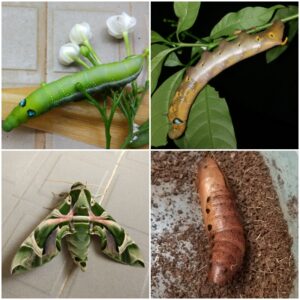
Another common garden pest is the familiar caterpillar. Caterpillars come in a bewildering array of sizes, shapes, colours and patterns, and just like snails and slugs are fascinating to watch even though plants are at the receiving end of their existence. They can devour plants rapidly, but I have personally not seen any more destructive ones than which feed upon the crape jasmine (pinwheel flower) plant. These caterpillars blend so well with the foliage that they are only seen once they reach a certain size. If they are not removed by this time, the damage to the plant is often fatal as they are voracious eaters; just two or three caterpillars can strip a medium-sized plant bare overnight! They can grow longer than the average human finger; branches often sag due to their weight. Having removed a fair few of these (released onto the same plants growing on the roadside, probably the source in the first place), I was curious to know what butterflies or moths they would grow into (I didn’t know the species at the time). One evening, I came across what at first appeared to be a dull, brown elongated oval in the garden. Turning it over, I quickly recognised that it was a pupa! Excited, I let it be, hoping to catch a glimpse of the adult that would emerge. A couple of days later, I headed to the same spot but the pupa had disappeared. I was naturally disappointed, and was heading back inside when I saw a moth struggling on the floor. It turned out that it wasn’t hurt or struggling at all, but had just recently emerged, and was spreading its wings out to dry and so wasn’t ready to fly yet. It was dark green, with a striking pattern resembling military camouflage. I discovered that this was an oleander hawk-moth, the adult form of the caterpillars I had seen. I felt truly lucky to have witnessed the entire life cycle of this beautiful insect.
Life on our planet comes in a multitude of forms, but we often remain oblivious to its presence. For those of us fortunate enough to have the opportunity to witness it, all it takes is some patience, luck, and the willingness to look down.